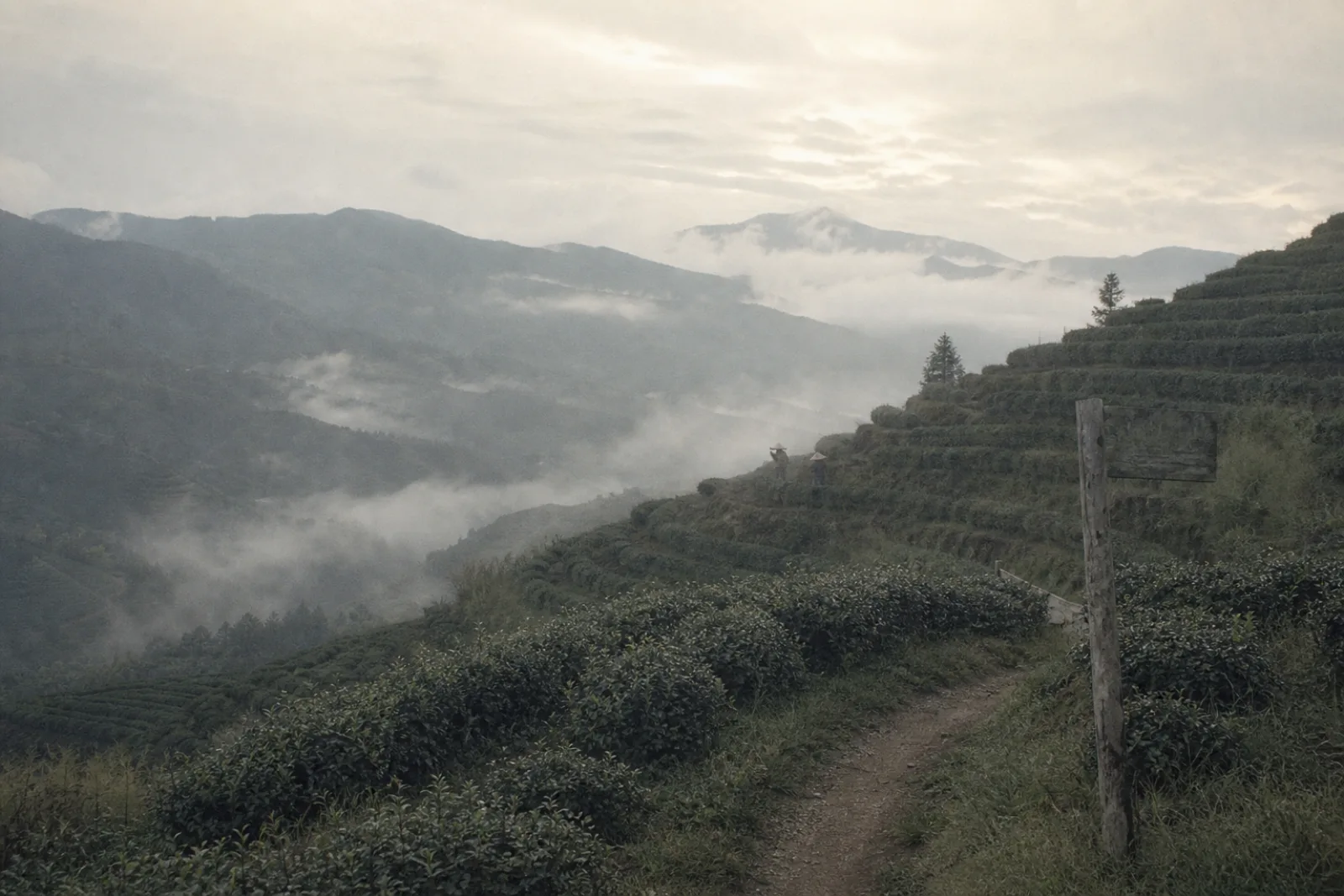
Why the harvest calendar drives the whole market
The Chinese tea year begins not on 1 January but with the spring equinox, when the first buds swell in the lowlands of Zhejiang and Fujian. For buyers across the supply chain — from boutique teahouses to commodity importers — the harvest calendar is the single most consequential timetable. It determines when lots can be sampled, priced, and shipped, and it separates the highest-grade Míngqián (pre-Qingming) teas from the higher-volume Yǔqián (pre-Grain Rain) yields that follow.
No two regions move in lockstep. In Fuding, the earliest Bái Háo Yín Zhēn (白毫银针) plucks begin as early as 12 March in warm springs, while the same cultivar planted at 1,200 m in Yunnan’s Menghai county may not produce a first flush until the second week of April. Oolong harvests on Phoenix Mountain typically run from late March for early Mì Lán Xiāng (蜜兰香) through to the end of April for the main Dān Cōng crop, after which processing and roasting add another 6–8 weeks before teas are ready to ship. Green teas, with their shorter processing window, often reach the market in mid-April, creating a frantic booking period for air freight.
tea.report’s series of articles construct a living map of this calendar. “2026 spring harvest calendar — region by region” breaks down expected opening dates for 18 counties across five provinces, while “2026 spring weather impact on Yunnan tea — region by region” details how a cool, dry March delayed the historic Gǔshù (ancient tree) plucks by 10–14 days, compressing the purchase window for pu-erh brokers. Logistics are equally time-sensitive: as the report “Shipping windows — when spring tea actually reaches EU and US ports” explains, a tea harvested on 5 April in Hangzhou typically arrives in Rotterdam on 25 April by air, but only in late June by sea — a gap that can erode terroir freshness and alter the pricing calculus for distributors.
The microclimate around Dongting Lake can shift the Jūnshān Yínzhēn harvest window in Hunan by nearly two weeks. In 2025, the lake effect gave four extra days of cool mornings, which extended the ideal picking period and produced an unusually fragrant batch. Such nuances ripple through auction prices and futures contracts, underscoring why harvest calendars are not static documents but probabilistic forecasts that reward those who track them closely. To deepen your understanding of harvest grades and regional seasonality, the tea.school curriculum offers structured courses, while tea.travel provides guided visits to gardens during peak plucking seasons — turning the calendar from a spreadsheet into an experience.